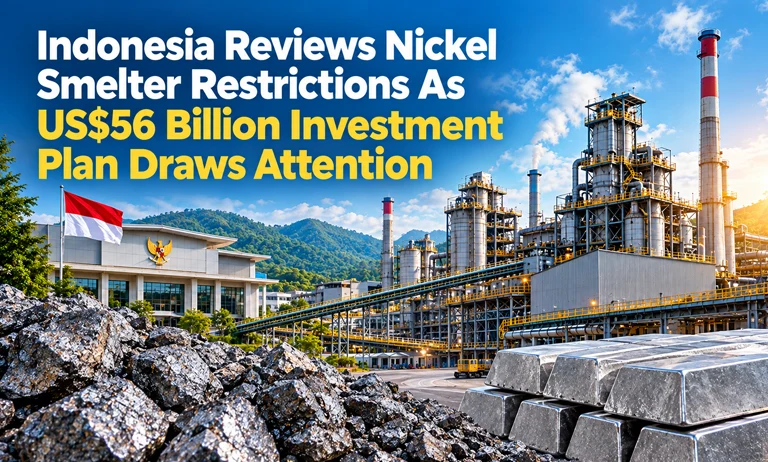
Planned nickel smelter investments for 2026–2029 are valued at US$56 billion. The government aims to shift downstream development from semi processed materials towards higher value finished products
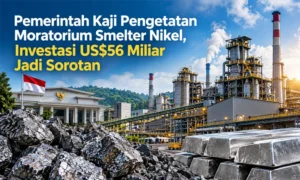
ICN News, Jakarta — The Indonesian government is reviewing the possibility of tightening restrictions on new nickel smelters producing semi processed products. The policy discussion has drawn attention across the mining industry, as the Indonesian Nickel Industry Forum (FINI) previously reported planned nickel smelter investments worth US$56 billion for the 2026–2029 period.
The investment figure highlights the scale of Indonesia’s nickel processing expansion. However, it does not mean that the entire amount is at risk or that the investments will be cancelled. FINI has indicated that the reported investment pipeline includes projects that have already entered the construction process, making regulatory certainty an important concern for industry players.
The proposed restrictions came back into focus after Bahlil Lahadalia, Coordinating Minister for Downstreaming and Energy Transition and Minister of Energy and Mineral Resources, said the government was evaluating the future direction of Indonesia’s nickel industry.
Bahlil made the remarks during the Investor Daily Summit 2026 in Jakarta on 7 October 2026. The government wants to identify which industries should continue to expand and which may need tighter controls on additional capacity.
US$56 BILLION INVESTMENT PIPELINE UNDER SCRUTINY
According to a report published by Bisnis.com on 26 November 2025, FINI put planned nickel smelter investments at approximately US$56 billion for the 2026–2029 period. The reported investment pipeline includes facilities that have entered the construction stage. The industry association has also called for clarity on how new requirements would apply to projects that are already underway.
FINI said the investment pipeline could potentially create around 50,000 direct jobs. Regulatory certainty is therefore important not only for investors but also for workers and supporting companies involved in the construction and operation of processing facilities.
Nevertheless, the US$56 billion figure represents planned investment reported for the 2026–2029 period, not the total amount of investment already realised. It should also not be interpreted as investment that will necessarily be lost because of the proposed restrictions.
For industry players, a key issue is how the government will apply any new restrictions while maintaining legal certainty for projects that have met the relevant requirements and commenced construction.
GOVERNMENT SEEKS TO SHIFT THE DIRECTION OF DOWNSTREAMING
The government believes that expanding smelting capacity alone is not enough to maximise the economic value of Indonesia’s nickel resources. The domestic industry is expected to move further along the value chain towards finished products with higher economic value.
Semi-processed nickel products commonly produced by the processing industry include ferronickel, nickel pig iron (NPI), nickel matte and mixed hydroxide precipitate (MHP).
Some of these products require further processing before they can be used in final materials or manufactured goods. The government wants to strengthen domestic downstream industries so that the economic benefits of nickel resources extend beyond the initial stages of smelting and refining.
Under this policy direction, further downstream investment including materials for electric vehicle battery supply chains and other nickel based manufacturing industries could receive greater attention.
A shift in priorities could influence investment decisions by companies planning new facilities. Investors may need to assess not only ore availability and smelting capacity, but also product specifications, target markets and the alignment of their projects with the government’s downstreaming strategy.
OVERSUPPLY RISKS ADD TO PRICE PRESSURE
In addition to increasing domestic value creation, the government has highlighted the risk of oversupply in the global nickel market. Bahlil said excess supply and global production capacity had put pressure on nickel prices. In a report published by ANTARA on 7 October 2026, he cited an estimated global surplus of approximately 2.5 million tonnes.
This situation is one of the factors behind the government’s review of additional processing capacity. If production of semi-processed nickel products continues to rise while demand grows more slowly, price pressure could affect company profitability and state revenue.
The government is therefore considering restrictions on further expansion in segments that risk generating excessive volumes of semi processed products, while encouraging downstream industries that offer higher economic value.
However, oversupply concerns do not mean that all existing smelters will be shut down. The impact will depend on the final policy, product categories, project status and applicable licensing requirements.
REGULATORY CERTAINTY IS CRITICAL FOR INVESTMENT
Requirements governing smelter development are addressed under Government Regulation No. 28 of 2025 on the Implementation of Risk-Based Business Licensing. The regulation includes provisions relevant to certain industrial activities producing intermediate nickel products.
The government’s discussion in October 2026 should therefore be viewed in the context of a policy review and possible tightening of implementation, rather than as an announcement that a comprehensive new moratorium is already in force.
For investors, clarity on the scope of any restrictions and the treatment of ongoing projects is essential. Smelter development requires substantial capital, long construction periods, reliable feedstock supplies and predictable market access.
Changes in requirements could affect construction schedules, financing structures, technology selection and product development strategies. The impact could also extend to construction contractors, heavy equipment suppliers, processing technology providers, mining service companies and supporting infrastructure businesses.
OPPORTUNITIES COULD SHIFT TOWARDS HIGHER VALUE PRODUCTS
A policy direction focused on finished products could create opportunities for further downstream processing. Companies may consider developing higher value products, provided that projects are supported by sound economics, suitable technology, reliable feedstock and sufficient market demand.
For Indonesia, the challenge is to balance investment attraction with sustainable mineral resource management and the development of domestic manufacturing.
The US$56 billion investment pipeline reported by FINI illustrates the scale of the economic interests associated with nickel smelter development. However, the success of downstreaming will not be measured solely by the number of smelters built. It will also depend on the industry’s ability to produce more competitive products with greater domestic value creation.
For mining industry players, the message is clear: Indonesia’s nickel investment landscape increasingly requires regulatory certainty, more selective capacity expansion and a stronger focus on higher value downstream products. The government’s next policy decisions will be an important factor in shaping investment and expansion strategies for 2026–2029.
Muslim M. Amin, Editor in Chief
ICN NEWS — Indonesian Coal & Nickel News
For advertising and subscriptions, please contact us via WA Or Email
Need a research report? Please visit CDMI Consulting