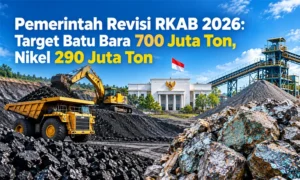
Coal production reached 423.71 million tonnes through July, while nickel ore production stood at 173.79 million tonnes as of 1 September 2026. The government has adjusted annual production targets amid efforts to balance supply, domestic demand, and downstream industry requirements.
ICN News, Jakarta — The Indonesian government has approved revisions to the 2026 Work Plan and Budget (RKAB), setting a coal production target of approximately 700 million tonnes and a nickel ore production target of around 290 million tonnes. Announced in October 2026, the adjustment represents a significant development for the country’s mining industry as the year approaches its final quarter.
Tri Winarno, Director General of Mineral and Coal at the Ministry of Energy and Mineral Resources (ESDM), announced the revised targets on 18 October 2026. The adjustment provides an updated picture of the government’s production policy for two of Indonesia’s strategic commodities. However, the annual targets must be distinguished from actual production recorded during 2026.
Data from ESDM reported by ANTARA showed that national coal production reached 423.71 million tonnes through July 2026. Meanwhile, figures cited in ANTARA’s English-language reporting showed nickel ore production at 173.79 million tonnes as of 1 September 2026. These figures cover different reporting periods and do not represent total production through October.
COAL PRODUCTION TARGET BELOW THE 2025 ACTUAL OUTPUT
Under the revised 2026 mining work plans, the government has set a coal production target of approximately 700 million tonnes. This is higher than the initial plan of around 600 million tonnes, but remains below the actual production recorded in 2025, which reached 817.48 million tonnes.
The revised 2026 target is therefore approximately 14.4% lower than the previous year’s actual output. The government has been pursuing an optimum production approach, aligning output with market demand, domestic requirements, price movements, logistics conditions, and the sustainability of reserves.
Through July 2026, coal production stood at 423.71 million tonnes. ESDM data also indicated that approximately 63.82% of production during the period was allocated for export, 26.86% for domestic consumption, and 9.32% was held as stock.
This composition highlights the importance of balancing export markets with domestic demand while maintaining sufficient stock to support reliable supply.
For mining companies, the revised national target serves as one of the key references for reviewing operational plans. However, each company’s production level remains subject to its approved RKAB, operational readiness, mining conditions, and applicable regulations.
NICKEL ORE PRODUCTION TARGET SET AT 290 MILLION TONNES
In the nickel sector, the government has approved a 2026 nickel ore production target of approximately 290 million tonnes. This represents an increase from the initial target range of around 250 million to 260 million tonnes.
On 7 October 2026, the Ministry of Energy and Mineral Resources had projected that annual nickel ore production could reach approximately 290 million tonnes. The projection was based on production developments through the third quarter and the performance of mining companies.
For comparison, Indonesia’s actual nickel ore production in 2025 was reported at approximately 320.37 million tonnes. The 2026 target is therefore around 9.5% below the previous year’s actual output.
ESDM data reported in September showed that nickel ore production had reached 173.79 million tonnes as of 1 September 2026. This figure represents cumulative production up to that date, not actual production through the end of September or October.
The development is important for nickel mining companies and operators of processing and refining facilities, commonly known as smelters. Ore availability is one of the factors influencing smelter capacity utilisation, while downstream demand also determines raw material requirements.
PLN’S COAL REQUIREMENTS REMAIN A KEY CONSIDERATION
In addition to production targets, the government has allocated approximately 154 million tonnes of coal to meet the requirements of state-owned electricity company PT PLN (Persero) throughout 2026. The allocation is linked to the Domestic Market Obligation (DMO), which requires mining companies to comply with domestic coal supply requirements under prevailing regulations.
Power generation demand remains an important consideration in determining national coal production. The government must ensure reliable energy supplies, while mining companies need to account for domestic obligations in their sales and shipment strategies.
At the same time, producers face changing export market conditions, commodity prices, transportation costs, and weather conditions that may affect coal distribution routes. Consequently, meeting production targets depends not only on mining capacity but also on logistics readiness and the ability to fulfil market requirements.
IMPLICATIONS FOR MINING COMPANIES AND SUPPLIERS
Changes in national production targets have implications for various participants across the mining industry. Mining contractors may need to adjust fleet deployment, workforce requirements, and overburden removal activities in line with actual production plans. Suppliers of heavy equipment, spare parts, fuel, and maintenance services must also monitor developments in their customers’ operations.
In the nickel sector, production adjustments warrant attention from smelter operators, processing technology suppliers, logistics companies, and downstream industry investors. Nevertheless, changes in national targets do not automatically result in equivalent production changes at every company. The impact depends on approved production quotas, operating capacity, buyer requirements, operating costs, and the conditions of individual mining operations.
For industry suppliers, developments in the RKAB framework provide one indicator for assessing demand prospects for mining equipment and services. Investment decisions, however, should also take into account actual contracts and the work plans of individual companies.
MONITORING ACTUAL OUTPUT THROUGH YEAR-END
The approval of the revised 2026 mining work plans provides an updated reference point for Indonesia’s coal and nickel industries. However, achieving the annual targets will depend on production developments during the remaining months, operating conditions, and the implementation of individual companies’ work plans.
To assess industry performance more comprehensively, actual production data through September and October will need to be monitored as the figures become available. These developments will help industry participants assess whether the government’s annual targets are likely to be achieved, how domestic supply and exports are evolving, and whether raw material requirements for processing industries are being met.
For Indonesia’s mining industry, the challenge at the end of 2026 is not simply to meet production targets. It also involves maintaining operational efficiency, fulfilling domestic supply obligations, and adapting business strategies to changing commodity market conditions.
Sources: Ministry of Energy and Mineral Resources (ESDM), ANTARA News, and Bloomberg Technoz; data and reports published in 2026.
Muslim M. Amin, Editor in Chief
ICN NEWS — Indonesian Coal & Nickel News
For advertising and subscriptions, please contact us via WA Or Email
Need a research report? Please visit CDMI Consulting