Indonesian miners and Asian buyers are taking a cautious approach to long-term supply agreements. Coal prices have strengthened amid concerns over production quotas, domestic supply obligations and changes to export oversight.
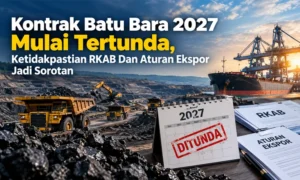
ICN News, Jakarta — Uncertainty over production quotas and changes to Indonesia’s coal export framework are beginning to affect negotiations for 2027 supply contracts. Several Indonesian mining companies and Asian coal buyers have reportedly delayed signing long term agreements while awaiting greater clarity on government policy.
In a report dated 15 October 2026, S&P Global Platts said some miners were considering adding protective clauses to supply contracts. These provisions link delivery commitments to approval of the Work Plan and Budget (RKAB) and compliance with Indonesia’s Domestic Market Obligation (DMO).
The development has drawn attention across the industry because annual contract negotiations typically take place in the fourth quarter. Without certainty over approved production volumes, miners face the risk of committing to supply quantities that may prove difficult to deliver if government approved quotas fall below expectations. For buyers, the uncertainty complicates supply planning and energy budget preparation for the following year.
SUPPLY CONTRACTS INCREASINGLY LINKED TO RKAB APPROVAL
The RKAB process has become a key factor in negotiations for 2027 coal contracts. Under this mechanism, the government approves mining companies’ production plans for the relevant period. Applications for the 2027 RKAB opened on 1 October and were scheduled to remain open until 15 November 2026. With the approval process still underway, some companies cannot yet confirm the production volumes available to fulfil export contracts next year.
According to S&P Global Platts, some miners are considering framework agreements under which supply commitments remain conditional on RKAB quota approval. The approach is intended to reduce the risk of contractual disputes if approved production volumes prove insufficient to meet delivery commitments.
Domestic Market Obligation requirements are another important consideration. Miners must account for the coal needed to serve the domestic market before determining how much production can be allocated for export.
This makes certainty over production and distribution increasingly important when negotiating long-term supply agreements.
EXPORT OVERSIGHT ENTERS A NEW PHASE
Another factor affecting negotiations is the changing framework for overseeing exports of strategic commodities, including coal. From 1 January 2027, PT Danantara Sumberdaya Indonesia (DSI) is scheduled to play a greater role in overseeing strategic commodity exports. According to S&P Global Platts, uncertainty over how the new system will operate has also made some miners and buyers more cautious.
DSI has previously indicated that its initial role would focus on export oversight and facilitation, while commercial relationships between miners and overseas buyers would continue. Market participants are nevertheless awaiting further clarity on the procedures and level of oversight to be applied when the system comes into operation.
For mining companies, changes to export procedures could affect documentation, shipment schedules and contract execution. Some companies are therefore seeking contractual protections against potential regulatory changes.
It is important to note that the reported uncertainty concerns the implementation of the new mechanism. It does not mean that Indonesian coal exports have been suspended or that all existing contracts have automatically been cancelled.
COAL PRICES STRENGTHEN AMID SUPPLY CONCERNS
Uncertainty over Indonesian supply has also attracted attention in international markets. S&P Global Platts price assessments showed higher prices for several coal benchmarks from Indonesia, Australia and South Africa.
The following table presents prices reported by S&P Global Platts on 14 October 2026 for three coal benchmarks.
Coal benchmark prices — 14 October 2026
| Coal benchmark | FOB price |
| Kalimantan, 4,200 kcal/kg GAR | US$78.55/tonne |
| Newcastle, 5,500 kcal/kg NAR | US$111.75/tonne |
| Richards Bay, 5,500 kcal/kg NAR | US$112.05/tonne |
Note: These figures are S&P Global Platts assessments dated 14 October 2026. They are not universal selling prices for all transactions.
The price of Indonesian Kalimantan coal with a calorific value of 4,200 kcal/kg GAR rose from around US$45/tonne in early January to US$78.55/tonne on 14 October 2026. Over the same period, the Newcastle benchmark for 5,500 kcal/kg NAR coal reached US$111.75/tonne, while the Richards Bay benchmark for coal of similar calorific value stood at US$112.05/tonne.
These increases reflect market conditions influenced by supply availability and demand. However, prices are also affected by other factors, including power-generation requirements, demand from importing countries, logistics costs and broader global energy-market conditions.
BUYERS MAY TURN TO THE SPOT MARKET
Some Asian buyers have reportedly opted for spot market purchases rather than committing to annual contracts, at least while awaiting greater clarity over supply availability in early 2027. This strategy offers flexibility when production volumes and export requirements remain uncertain. However, spot purchases also expose buyers to price volatility and uncertainty over cargo availability.
If production quotas remain tight in 2027, Indonesian coal supplies available for export could become more constrained. Buyers may then face greater competition for available cargoes and consider alternative sources of supply. For miners, higher prices could create opportunities to increase revenue. The actual benefit will depend on approved production volumes, operating costs, domestic supply obligations and the ability to fulfil contractual commitments.
PRODUCTION CERTAINTY WILL BE CRITICAL FOR 2027
The contract negotiations illustrate that the challenges facing Indonesia’s coal industry extend beyond selling prices. Certainty over production volumes, implementation of the DMO and export procedures will also influence companies’ ability to meet buyer demand.
Miners need to ensure that sales commitments are consistent with production volumes that can be approved and delivered. Buyers, meanwhile, must account for supply risks and prepare more flexible procurement strategies. For mining contractors, transportation companies, heavy equipment suppliers and other service providers, changes in production volumes could affect operating requirements and project planning.
As 2027 approaches, RKAB certainty and the export oversight framework will be key factors shaping contract negotiations, supply availability and the competitiveness of Indonesian coal in international markets. The progress of RKAB approvals and the implementation of the export oversight system early next year will remain major areas of attention for industry participants.
Muslim M. Amin, Editor in Chief
ICN NEWS — Indonesian Coal & Nickel News
For advertising and subscriptions, please contact us via WA Or Email
Need a research report? Please visit CDMI Consulting