Delayed mining approvals, a sharp share-price decline, Jhonlin’s acquisition, and substantial share-backed financing raise questions that warrant transparent answers.
ICN News, Jakarta — A series of developments involving PT Bayan Resources Tbk. (BYAN), the Jhonlin business group owned by Andi Syamsuddin Arsyad, widely known as Haji Isam, and state-owned lender PT Bank Mandiri (Persero) Tbk. has attracted the attention of market participants and the wider public.
The issue began with delays in the approval of the 2026 revised Work Plan and Budget (RKAB) for three Bayan subsidiaries. The situation led to a declaration of force majeure, affecting the companies’ ability to fulfil coal supply contracts with customers.
During the same period, an agreement emerged for the sale of a substantial stake in Bayan to Jhonlin Baratama. The government subsequently approved the revised RKABs for the three subsidiaries. Meanwhile, the acquisition, valued at approximately Rp26.1 trillion, was completed in October 2026, as public attention also turned to Bank Mandiri’s credit facilities and shares pledged as collateral by companies affiliated with Jhonlin.
The timing of these developments has raised questions about the relationship between mining approvals, share-price movements, the acquisition, and financing arrangements. However, any causal links between these events remain unproven and require further examination.
RKAB Delays Disrupt Three Bayan Subsidiaries
On 14 September 2026, Bayan Resources announced that three of its subsidiaries—PT Tiwa Abadi, PT Tanur Jaya, and PT Fajar Sakti Prima—had experienced force majeure because approval of their revised 2026 RKABs had not yet been issued.
Management explained that the three companies had submitted their applications in accordance with the applicable requirements. However, without the necessary RKAB approvals, they could not proceed with production as planned. The situation affected their ability to fulfil coal supply commitments to customers.
The issue was significant because RKAB approval directly affects a mining company’s ability to conduct legally authorised production, meet contractual obligations, and maintain operational continuity.
For mining companies, delays in production quota approvals can affect revenue, cash flow, customer relationships, and investor perceptions of business risk.
This raises a fundamental question: why had the revised RKAB approvals for the three subsidiaries not been issued when the operational difficulties were announced publicly? Were the delays attributable solely to technical and administrative assessments, or were other factors involved in the decision-making process?
These questions require answers supported by application records, assessment timelines, explanations for the delays, and official statements from the relevant authorities.
Share Prices Fall As The Acquisition Moves Forward
The regulatory uncertainty unfolded as the market was also monitoring the possibility of a major change in Bayan’s shareholding structure.
In August 2026, speculation circulated about a potential acquisition of a substantial Bayan stake by Haji Isam. BYAN shares reached a closing price of Rp17,125 on 18 August before subsequently declining.
On 15 September, the shares briefly touched Rp10,075 during intraday trading, amid uncertainty surrounding the RKAB approvals and speculation about the transaction. The movement reflected a substantial shift in market expectations over the period.
On 16 September 2026, Bayan shareholders Dato’ Low Tuck Kwong and Elaine Low signed a conditional share purchase agreement with PT Jhonlin Baratama.
The transaction was subsequently completed on 7 October 2026. According to disclosures reported on 8–9 October, Jhonlin Baratama acquired 10,084,088,370 BYAN shares, representing approximately 30.25% of the company.
The reported transaction value was approximately Rp26.1 trillion, at an acquisition price of around Rp2,588 per share.
It is important to distinguish this negotiated transaction price from the market price of BYAN shares traded on the stock exchange. A meaningful comparison must consider the transaction structure, the timing of price determination, the terms of the agreement, and the mechanism used to transfer the shares.
The fact that the acquisition took place after a decline in the market price warrants examination. However, that sequence alone does not establish that the decline was deliberately engineered to benefit the buyer.
Testing such a hypothesis would require evidence concerning the negotiation process, the timing of the agreed price, communications between the parties, and any conduct that might indicate market manipulation.
RKAB Approvals Issued After The Share Agreement
The subsequent developments represent another important point in the chronology.
On 23 September 2026, the three Bayan subsidiaries received full approval of their revised 2026 RKABs. Following the approvals, Bayan announced that it was withdrawing the force majeure declarations previously applied to its coal supply obligations.
Additional production quotas reported for the subsidiaries were in the range of 15–20 million tonnes. The approvals enabled the companies to prepare for the resumption of mining, transportation, and coal sales activities.
The sequence has attracted attention because the conditional share purchase agreement with Jhonlin Baratama had been signed on 16 September, while the RKAB approvals were issued on 23 September.
Energy and Mineral Resources Minister Bahlil Lahadalia denied that the issuance of the RKAB approvals was connected to the share transaction. The government stated that the companies had fulfilled the required administrative conditions.
The government’s explanation is an important part of the story and must be reported fairly. At the same time, the chronology leaves room for further examination of the approval process and the timing of the decisions.
To establish whether the process followed the applicable procedures, the public would benefit from a more detailed explanation of the application dates, assessment stages, any outstanding documentation, the fulfilment of requirements, and the basis for granting the additional production quotas.
Without this information, the proximity between the share agreement and the RKAB approvals remains a chronological fact rather than proof of a causal relationship.
Bank Mandiri Credit And Rp73 Trillion In Share Collateral
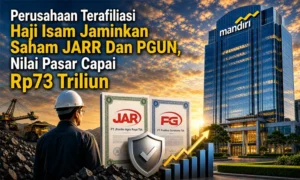
Public attention subsequently expanded to credit facilities involving Bank Mandiri, Jhonlin Baratama, and shares in two companies affiliated with the business group: PT Jhonlin Agro Raya Tbk. (JARR) and PT Pradiksi Gunatama Tbk. (PGUN).
According to a Bisnis.com report dated 10 October 2026, the pledged shares had an estimated market value of approximately Rp73 trillion based on their closing prices on 8 October. This figure represents an estimated collateral value, not a confirmed loan amount of Rp73 trillion.
The distinction is important. Collateral value, the approved credit facility, and the amount actually drawn down are three different figures.
On 16 October 2026, Bank Mandiri explained that its credit facilities to Jhonlin Baratama were intended to support business development, capital expenditure, and financing requirements in coal mining and related sectors. The bank stated that the facilities were not intended to finance share trading.
Meanwhile, an October 2026 report by Katadata examined market questions about a possible relationship between the financing and the BYAN acquisition. The report noted that the timing of the two events did not establish that the credit facilities had been used to finance the acquisition.
Several details still require clarification: the total credit facility approved, the amount actually disbursed, the recipients and use of the funds, the basis for the credit assessment, and how Bank Mandiri ensures that the facilities are used for their stated purposes.
The public also needs to distinguish between the bank’s statement that the credit was not intended for share trading and the separate question of whether the financing had any economic connection with the acquisition. These are different issues that require evidence-based explanations.
Questions Of Transparency And Corporate Governance
The Bayan case illustrates how regulatory approvals, share-price movements, ownership transactions, and bank financing can converge within a relatively short period and attract significant market attention.
From a corporate governance perspective, several questions deserve transparent answers.
First, how was the revised RKAB assessment conducted, and what was the basis for granting approval to the three Bayan subsidiaries on 23 September?
Second, how was the acquisition price determined, and what information did the parties rely on when agreeing to a transaction valued at Rp26.1 trillion?
Third, how did Bank Mandiri assess creditworthiness, repayment capacity, collateral quality, and the risks associated with a sharp decline in the market value of the pledged shares?
Fourth, did the processes comply with applicable disclosure requirements, corporate governance standards, banking regulations, and capital market rules?
These questions do not, in themselves, establish that any violation occurred. Rather, documented answers would help distinguish legitimate business decisions from potential irregularities that may warrant regulatory scrutiny.
Conclusion: The Chronology Must Be Tested Against Evidence
As of 22 October 2026, available information indicates that the RKAB dispute, the Bayan share acquisition, and Bank Mandiri’s credit facilities were developments that occurred within a relatively close timeframe.
However, publicly available evidence is not sufficient to conclude that the RKAB delays were deliberately intended to depress the share price, that the subsequent approvals were connected to benefits for the buyer, or that the credit facilities were misused.
The appropriate next step is to seek detailed responses from the Ministry of Energy and Mineral Resources, Bayan Resources, Jhonlin Baratama, and Bank Mandiri. Capital market and banking regulators also have roles, within their respective mandates, in ensuring transparency and compliance with applicable requirements.
For Indonesia’s coal industry and investors, the central lesson is the importance of regulatory certainty, transparent transactions, and sound financing governance. Market confidence depends not only on the size of a transaction, but also on the clarity of the process and the ability of the parties involved to address public questions with verifiable facts.
For advertising and subscriptions, please contact us via WA Or Email
Need a research report? Please visit CDMI Consulting