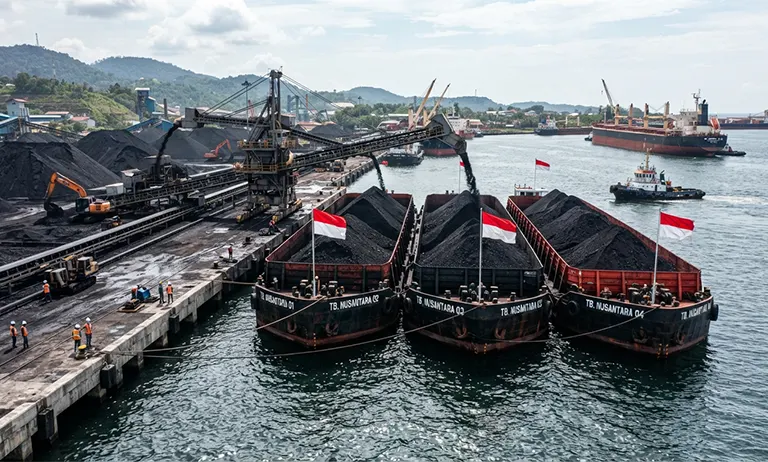
Dominance in supply does not automatically translate into the power to determine global coal prices. The government is now relying on production controls through the RKAB mechanism to strengthen Indonesia’s bargaining position in international markets
ICN News, Jakarta – Indonesia holds a highly dominant position in the international coal trade. In 2025, Indonesia supplied approximately 540 million tonnes out of a total global seaborne coal trade of around 1.3 billion tonnes. Minister of Energy and Mineral Resources Bahlil Lahadalia stated that this contribution represented approximately 43% of internationally traded coal supplies.
This figure highlights Indonesia’s strategic importance in meeting global energy demand. However, its substantial contribution to international supply has not yet translated into an equivalent ability to influence global coal price formation.
This is precisely the issue that has drawn the government’s attention. Bahlil has pointed out that Indonesian coal prices remain heavily influenced by international trading mechanisms and overseas market participants, including global commodity trading companies.
This raises an important question: why has a country supplying nearly half of internationally traded coal not yet gained comparable influence over the commodity’s pricing?
LARGE SUPPLY, BUT LIMITED BARGAINING POWER
According to Bahlil, global coal consumption reaches approximately 8.9 billion tonnes annually. Of this amount, around 1.3 billion tonnes are traded internationally. Indonesia contributed approximately 540 million tonnes in 2025.
Such a substantial supply volume should provide Indonesia with a strong foundation to strengthen its bargaining position. However, high production levels without disciplined supply management can create an oversupply situation and put downward pressure on selling prices.
Bahlil noted that in 2025, when Indonesia’s coal production was exceptionally high, coal prices remained relatively low. This affected mining companies’ profitability and resulted in less-than-optimal state revenues.
In other words, a large sales volume does not necessarily generate optimal revenue when selling prices are under pressure.
RKAB BECOMES A KEY PRODUCTION CONTROL INSTRUMENT
To address this issue, the government has begun tightening production controls through the Work Plan and Budget (RKAB) mechanism.
This policy aims to align production with market demand, preventing excessive supply and helping maintain coal prices.
Speaking at the Minerba Convention & Exhibition (Minerba Convex) 2026 in Jakarta on November 2, 2026, Bahlil stated that production controls were beginning to deliver results. He cited a coal price of approximately US$154 per tonne for coal with a calorific value of 6,322 kcal/kg GAR.
The government also indicated that Indonesia’s coal production in 2026 was expected to be lower than the 2025 realization of approximately 817 million tonnes.
Bahlil emphasized that more controlled production does not necessarily mean lower revenues. On the contrary, if supply is properly managed and prices improve, sales values and state revenues could increase.
THE CHALLENGE OF GAINING GREATER INFLUENCE IN GLOBAL MARKETS
Nevertheless, controlling domestic production does not automatically give Indonesia the ability to determine global coal prices unilaterally.
International coal prices are shaped by various factors, including demand from major consuming countries, supply availability from other producing nations, coal quality, transportation costs, as well as international trading transactions and benchmark pricing mechanisms.
Therefore, strengthening Indonesia’s market position requires more than simply reducing production. Consistent policies, transparent trading practices, improved product quality, and stronger international marketing capabilities are also essential.
Indonesia has significant advantages, particularly its large supply capacity and strategic geographical position in serving Asian markets. However, these advantages must be translated into greater economic strength for domestic mining companies and the country.
TOWARDS BECOMING A MARKET-SHAPING POWER
Indonesia’s dominance in international coal trade represents a strategic advantage that few other producing countries possess.
The next challenge is to transform its position as the world’s leading supplier into greater pricing influence, stronger bargaining power for national mining companies, and increased state revenues.
With consistent production and trade management, Indonesia has the potential to strengthen its influence in the global coal industry.
After all, being the world’s largest supplier is one thing, but having the power to determine the economic value of the commodity being supplied is a far greater challenge.
—
ICN NEWS
Research-Based Mining Magazine
Muslim M. Amin
Editor in Chief
For advertising and subscriptions, please contact us via WA Or Email
Need a research report? Please visit CDMI Consulting