What Lies Behind the Widjaja Family’s Departure from Several Strategic Positions?
ICN News, Jakarta – Major changes are taking place within the leadership structures of several publicly listed companies affiliated with Sinar Mas Group. Between June and November 2026, a number of strategic positions previously held by members of the Widjaja family, the successors to Sinar Mas’ founder, underwent significant changes.
The developments have attracted attention from capital market observers and Indonesia’s business community. The individuals stepping down are no ordinary corporate figures. They are members of a family that has played a central role for decades in building and expanding one of Indonesia’s largest business conglomerates.
At least five strategic positions across four publicly listed companies – PT Puradelta Lestari Tbk (DMAS), PT Bumi Serpong Damai Tbk (BSDE), PT Dian Swastatika Sentosa Tbk (DSSA), and PT Sinar Mas Agro Resources and Technology Tbk (SMAR) – have been vacated by three members of the Widjaja family.
The question now is whether these changes are simply part of a leadership succession process or whether broader business considerations are behind the developments.
FIVE STRATEGIC POSITIONS UNDERGO LEADERSHIP CHANGES
The changes began in June 2026. Muktar Widjaja resigned from his position as President Commissioner of PT Puradelta Lestari Tbk on June 15, 2026. Two days later, on June 17, he also stepped down as President Commissioner of PT Bumi Serpong Damai Tbk.
At the same time, Michael Jackson Purwanto Widjaja, Muktar Widjaja’s son, resigned from his position as Vice President Director of BSDE.
Further changes followed in the energy and mining businesses. Franky Oesman Widjaja resigned as President Commissioner of PT Dian Swastatika Sentosa Tbk on September 10, 2026.
Most recently, at an Extraordinary General Meeting of Shareholders held on November 17, 2026, Franky also stepped down as President Commissioner of PT Sinar Mas Agro Resources and Technology Tbk (SMAR), the company known for its SMART brand.
The position of President Commissioner at SMAR was subsequently entrusted to David Fernando Audy. He had previously replaced Franky in the same position at DSSA.
As a result, five strategic positions across four publicly listed companies affiliated with Sinar Mas underwent changes within approximately five months.
REGULATORY PRESSURE UNDER THE SPOTLIGHT
The leadership changes have taken place amid growing regulatory scrutiny of several issues within Indonesia’s capital market.
On October 16, 2026, the Financial Services Authority (OJK) announced administrative sanctions amounting to Rp1.5 trillion against PT Sinar Mas Tunggal, the controlling shareholder of DSSA, in connection with violations involving DSSA shares.
Following its investigation, OJK identified market manipulation practices involving individual and institutional clients through several securities companies. The practices were considered systematic and structured, resulting in a significant increase in DSSA’s share price.
It is important to note that the Rp1.5 trillion sanction was imposed on PT Sinar Mas Tunggal, not on DSSA as a publicly listed company. OJK also outlined sanctions against several securities companies involved in the case.
The matter has attracted considerable attention because DSSA is one of the key companies within Sinar Mas Group’s business portfolio, particularly in the energy and mining sectors.
However, no official statement has established a direct connection between the regulatory case and Franky Widjaja’s resignations from DSSA and SMAR.
DSSA: ONE OF SINAR MAS’ KEY COAL BUSINESS PILLARS
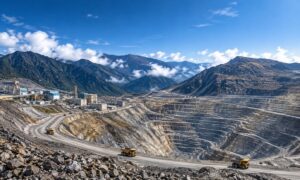
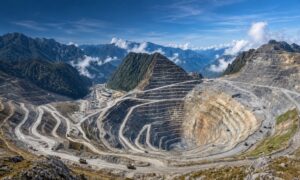
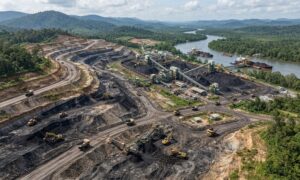
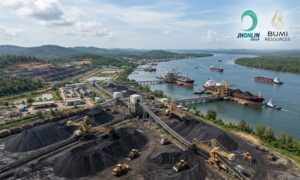
For Indonesia’s mining industry, the leadership changes at DSSA carry particular significance. The company represents one of Sinar Mas’ major coal business pillars through its subsidiaries, PT Golden Energy Mines Tbk (GEMS) and PT DSSE Energi Mas Utama.
Through these entities, DSSA operates across coal exploration, production, and trading activities, serving both domestic and export markets.
The scale of its operations is substantial. In 2025, DSSA’s coal production reached 54.95 million tonnes. Meanwhile, revenue from its coal mining and trading segment amounted to approximately US$2.49 billion, making it the largest contributor to the company’s consolidated revenue.
These figures highlight DSSA’s strategic position within Sinar Mas’ business portfolio, particularly in the energy and mining sectors.
Against this backdrop, Franky Oesman Widjaja’s resignation as President Commissioner of DSSA in September 2026 has drawn particular attention from the coal industry.
The position was subsequently entrusted to David Fernando Audy. The leadership transition is worth watching as DSSA continues to develop its business portfolio beyond coal and power generation, including renewable energy and digital infrastructure.
For the mining industry, the next challenge will be how the company maintains its production scale, strengthens corporate governance, and sustains its competitiveness amid changes in the global energy market.
INTERNATIONAL SCRUTINY OVER LAND AND FOREST FIRES
Attention toward several major Indonesian business groups has also intensified following forest and land fires that have contributed to transboundary haze.
In October 2026, Singaporean authorities summoned several Indonesian corporate executives to seek clarification regarding alleged links between their companies and land fires that affected air quality in the region.
Franky Oesman Widjaja was among the business figures who attended the meeting.
Nevertheless, being summoned to provide clarification should not be interpreted as proof that an individual or company has committed any violation.
The issue remains relevant because it reflects growing international scrutiny of environmental concerns, particularly those associated with Indonesia’s plantation and forestry industries.
LEADERSHIP SUCCESSION OR A BROADER BUSINESS STRATEGY RESET?
Amid these developments, one important aspect to watch is the changing composition of leadership across several Sinar Mas companies.
The appointment of David Fernando Audy as President Commissioner at both DSSA and SMAR reflects a shift in responsibilities toward a corporate professional with extensive business experience.
Such a move could form part of broader efforts to strengthen corporate governance, enhance professionalism, and align leadership structures with the companies’ future business requirements.
At the same time, the departure of several Widjaja family members from strategic positions raises questions about the direction of leadership succession within the conglomerate.
Is Sinar Mas accelerating the separation between the roles of the founding family and professional corporate management? Or are these changes part of a broader review of the group’s organizational structure and business strategy?
So far, no official explanation has linked all these resignations to a single decision or a group-wide restructuring agenda.
SINAR MAS REMAINS A MAJOR BUSINESS FORCE
Despite the changes in its corporate leadership, Sinar Mas remains one of Indonesia’s largest business groups, with a broad portfolio spanning multiple industries.
Its business activities cover pulp and paper, agribusiness and food, property, energy, mining, financial services, and telecommunications.
Consequently, leadership changes within its publicly listed companies deserve attention not only from investors but also from industry players that maintain business relationships with the group.
One point is clear: the departure of several Widjaja family members from corporate positions does not mean that the founding family has left Sinar Mas.
Franky Widjaja, for example, continues to serve as Chairman and CEO of Golden Agri-Resources (GAR), the Sinar Mas agribusiness holding company listed on the Singapore Exchange.
A NEW CHAPTER FOR SINAR MAS?
The wave of resignations marks a potentially significant new chapter in the development of one of Indonesia’s largest conglomerates.
Leadership changes can create opportunities to strengthen professionalism and corporate governance. However, amid growing attention to capital market and environmental issues, these developments will continue to be closely monitored by investors and the wider business community.
Are these changes part of a long-planned leadership succession process, or do they represent a strategic repositioning to address increasingly complex business challenges?
The answer remains to be seen.
For investors and industry players, the most important issue is not simply who leaves a corporate position, but how these leadership changes will influence business direction, investment strategies, and the future performance of Sinar Mas companies.
—
Muslim M. Amin
Editor in Chief
ICN NEWS
Research-Based Mining Media
For advertising and subscriptions, please contact us via WA Or Email
Need a research report? Please visit CDMI Consulting