East Kalimantan coal to methanol project targets initial production capacity of 2 million tonnes per year, with the potential to strengthen Indonesia’s chemical industry and reduce dependence on imports
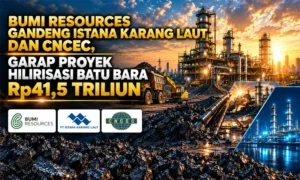
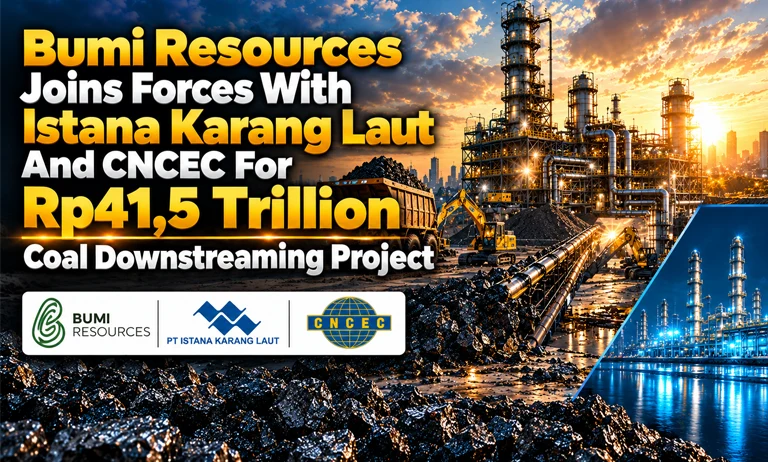
ICN News, Jakarta — Indonesia’s coal downstreaming industry is entering a new phase with the development of a coal-to-methanol gasification project in East Kutai Regency, East Kalimantan. With an investment value of more than US$2.3 billion, equivalent to approximately Rp41.5 trillion, the project involves PT Bumi Etam Chemical (BEC), PT Istana Karang Laut (IKL), and China National Chemical Engineering Co., Ltd. (CNCEC).
BEC’s involvement in the project also brings PT Bumi Resources Tbk (BUMI), through its subsidiaries PT Arutmin Indonesia and PT Kaltim Prima Coal (KPC), into one of Indonesia’s major coal downstreaming initiatives. BEC is a joint venture established by Arutmin and KPC to develop a coal-based methanol production facility.
On July 29, 2026, BEC signed a Front-End Engineering Design (FEED) agreement and an Engineering, Procurement, Construction, and Commissioning (EPCC) Framework Agreement with IKL and CNCEC. The agreements represent an important step in the project’s technical preparation and implementation. The government has put the project’s investment value at approximately US$2.3 billion.
BUMI, IKL, AND CNCEC IN THE COAL DOWNSTREAMING VALUE CHAIN
The project demonstrates collaboration between coal mining companies, an industrial partner, and an international engineering company. For BUMI, through Arutmin and KPC, methanol development provides a pathway to convert low-rank coal into higher-value chemical products.
Meanwhile, IKL and CNCEC are identified as partners in the project’s development, covering engineering and the framework for procurement, construction, and commissioning. The specific responsibilities of each party should be understood in accordance with the agreed contractual scope and division of work.
The project has progressed beyond the planning stage. On August 31, 2026, BEC held a groundbreaking ceremony at Batuta Chemical Industrial Park (BCIP), in Bengalon District, East Kutai Regency, East Kalimantan. The event marked the start of physical construction of the coal-to-methanol gasification project.
INITIAL CAPACITY OF 2 MILLION TONNES OF METHANOL PER YEAR
In its initial phase, the facility is designed to produce approximately 2 million tonnes of methanol annually. To support this output, the project is estimated to require around 7.7–7.78 million tonnes of low-rank coal each year.
The use of low rank coal is a significant aspect of the project. Resources whose utilization has traditionally been more limited can be processed through gasification technology to produce higher-value chemical feedstocks.
BEC has also indicated that production capacity could potentially be expanded in stages to 3.6 million tonnes of methanol per year. However, this represents a potential future expansion rather than production capacity that has already been realized.
The planned facilities include gasification units, synthesis reactors, power generation, water treatment, and a port terminal. The government has also referred to plans to integrate emissions-control technology and Carbon Capture and Storage (CCS). Commissioning is targeted for 2029.
REDUCING IMPORTS AND STRENGTHENING THE CHEMICAL INDUSTRY
One of the project’s main objectives is to reduce Indonesia’s dependence on imported methanol. This product is used in various sectors, including petrochemicals, formaldehyde production, manufacturing, and several segments of the energy and downstream industries.
According to figures cited by the government when the project was announced, Indonesia imported approximately 1.3 million tonnes of methanol in 2025, valued at around Rp7.1 trillion. The establishment of domestic production capacity is expected to help meet local demand and reduce foreign-exchange expenditure.
Nevertheless, the extent to which the project can substitute for imports will depend on actual production capacity, product quality, domestic methanol prices, and the facility’s ability to meet the requirements of industrial users. Achieving construction and commissioning targets will therefore be critical to the project’s success.
MAJOR INVESTMENT, SIGNIFICANT EXECUTION CHALLENGES
With an investment value of approximately Rp41.5 trillion, the BEC project represents a major capital-intensive coal downstreaming initiative requiring substantial investment and advanced technology. The challenge is not limited to constructing the facility. It also involves ensuring technological readiness, reliable coal supply, supporting infrastructure, operational efficiency, and the competitiveness of domestically produced methanol.
BEC President Director Rio Supin previously stated that the company had no plans for additional coal downstreaming projects beyond the current methanol project. Given the substantial investment required, the company would focus on completing the project under development. Other projects could be considered again after the current facility was operational and had demonstrated success.
This statement is particularly relevant amid government discussions about developing other coal derived products, including synthetic gasoline. The confirmed involvement of BUMI through Arutmin and KPC, together with IKL and CNCEC, relates to the coal to methanol project. There is not yet sufficient confirmation to conclude that these companies will also participate in a coal-to-gasoline project.
Going forward, the success of the BEC project will be an important benchmark for Indonesia’s coal downstreaming ambitions. If production capacity, efficiency, and operational targets are achieved, the project could strengthen domestic chemical feedstock supplies while increasing the added value generated from Indonesia’s coal resources.
Muslim M. Amin, Editor in Chief
For advertising and subscriptions, please contact us via WA Or Email
Need a research report? Please visit CDMI Consulting